Honeysmith Bees & Gardens
A garden center, apiary, and country market in Crownsville, Maryland — with a 5.0 Google rating across 258+ reviews and no website that did the place justice. Here's the build, piece by piece.
The problem
Honeysmith isn't one business — it's five. A garden center, a working apiary with a live observation hive, an on-site hydroponic farm, a country market, and a calendar of seasonal events. They ran their store on Square. The challenge: one website that captures all of it, sells online, and doesn't force them to manage inventory in two places.
The build: a custom site on top of Square
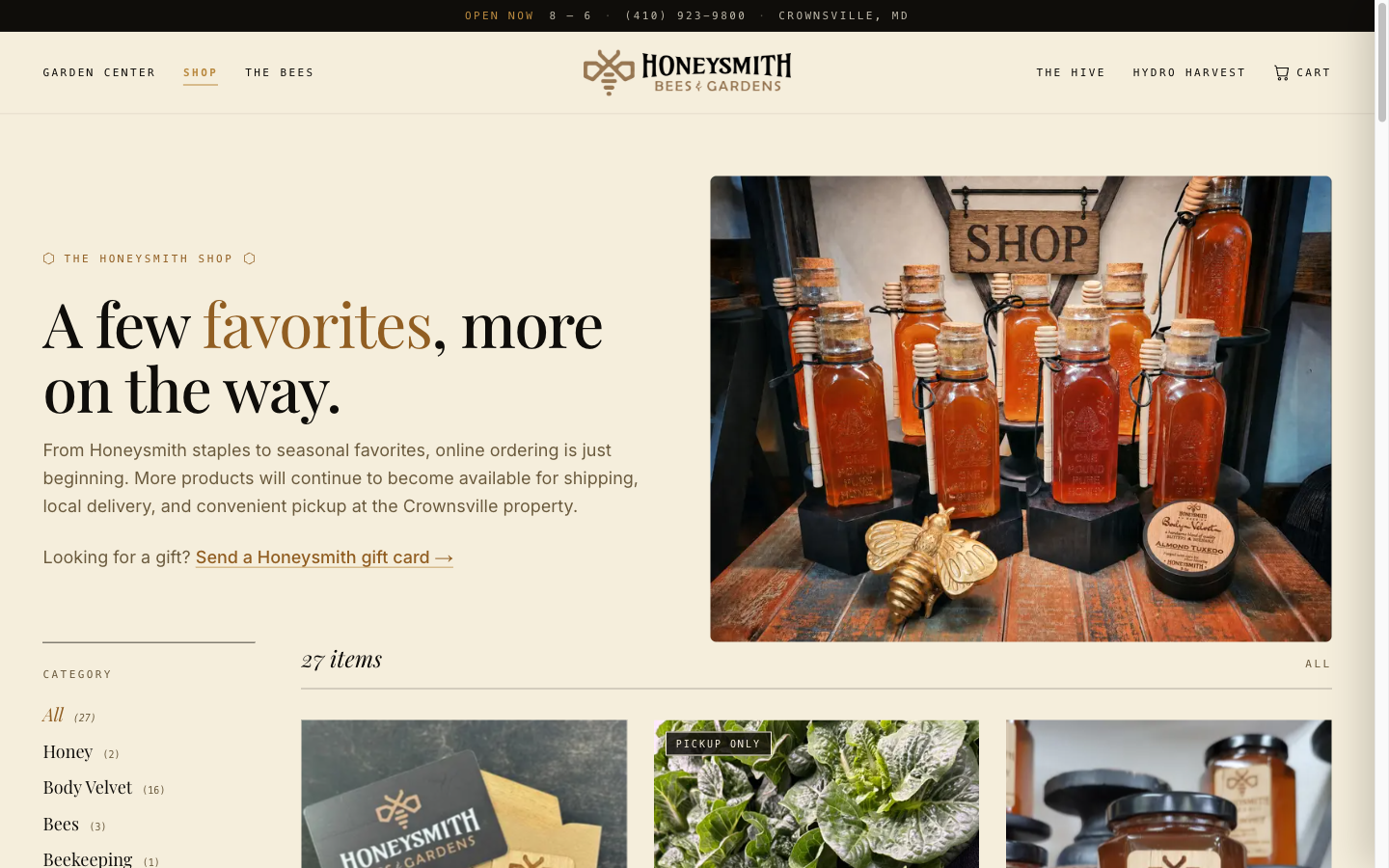
Most Square merchants get stuck with Square's own site builder — functional, but it looks like Square, not like you. So I built the opposite: a fully custom-designed, hand-coded site that talks to Square through its API underneath.
What that means in practice: the products, prices, and inventory live in Square — the same system the register already runs on. The website pulls the catalog through the API, so when they update a product in the store, the site updates itself. Cart and checkout run through Square too, with gift cards, and shipping, local delivery, or pickup at the property. Staff never touch the website to manage it. They just run their store.
The design
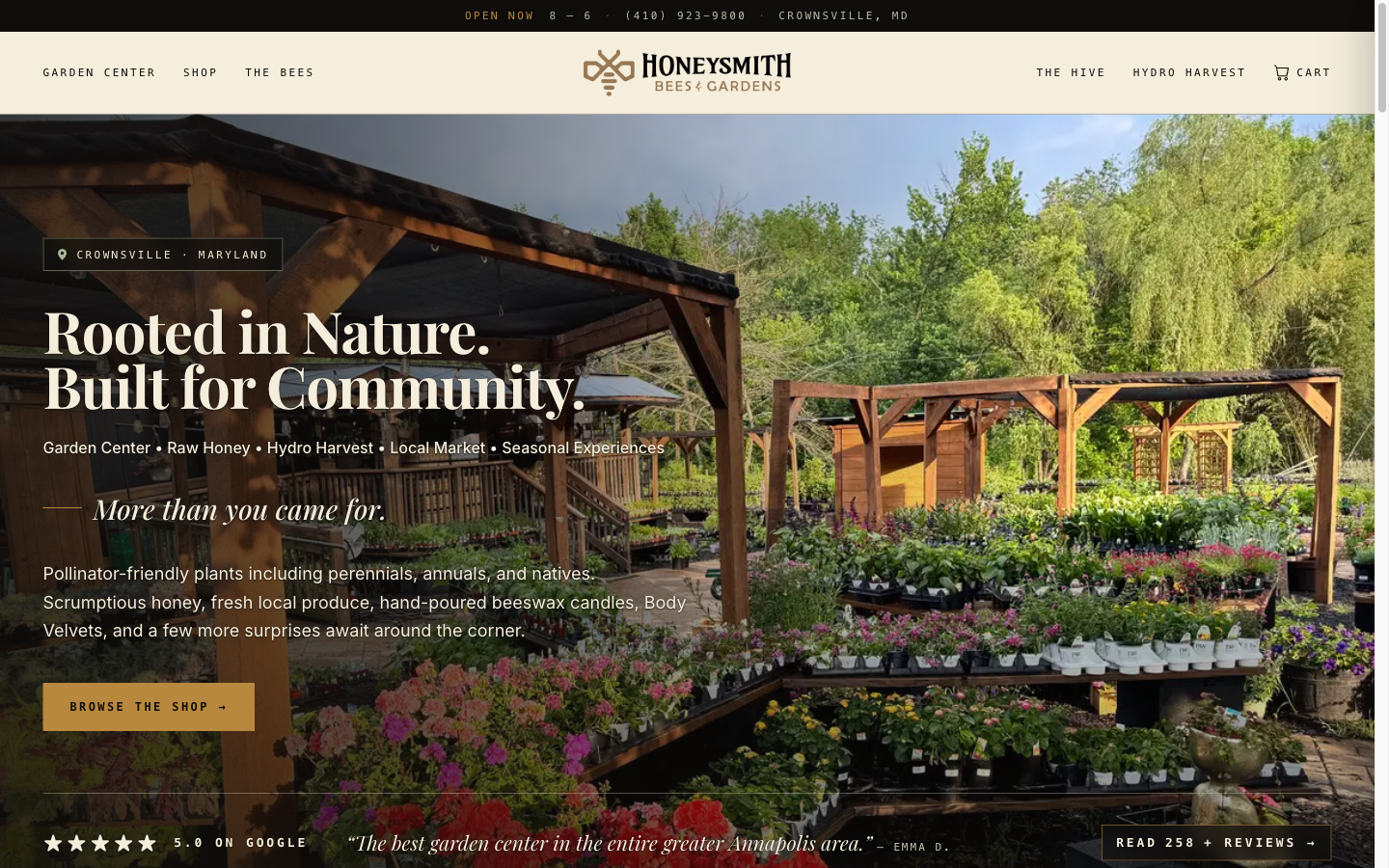
Visitors describe Honeysmith as a place you stay longer than you meant to — porch cats, macramé, honey jars, the observation hive. The design had to bottle that. Warm cream and honey tones, editorial typography, and real photography of the property and products, not stock. Every page — Garden Center, Shop, The Bees, Hydro Harvest, The Hive loyalty program, Events — got its own art direction under one consistent brand.
The proof, front and center
Honeysmith's best marketing asset was invisible: a perfect 5.0 rating across 258+ Google reviews. The site puts it to work — pulled into the hero, quoted throughout, and linked straight to Google so anyone can verify it. Social proof you've earned should never sit buried on a Maps listing.
build-sheet.md
Square API integration
Catalog, inventory, cart, checkout, and gift cards — one source of truth with the register
Fully custom design
No theme, no builder — designed and hand-coded for the brand
Flexible fulfillment
Shipping, local delivery, and on-property pickup per product
Loyalty built in
"The Hive" rewards program presented and promoted on-site
5.0 · 258+ reviews surfaced
Google reviews woven through the site and linked for verification
Six distinct sections
Garden Center · Shop · The Bees · Hydro Harvest · The Hive · Events